
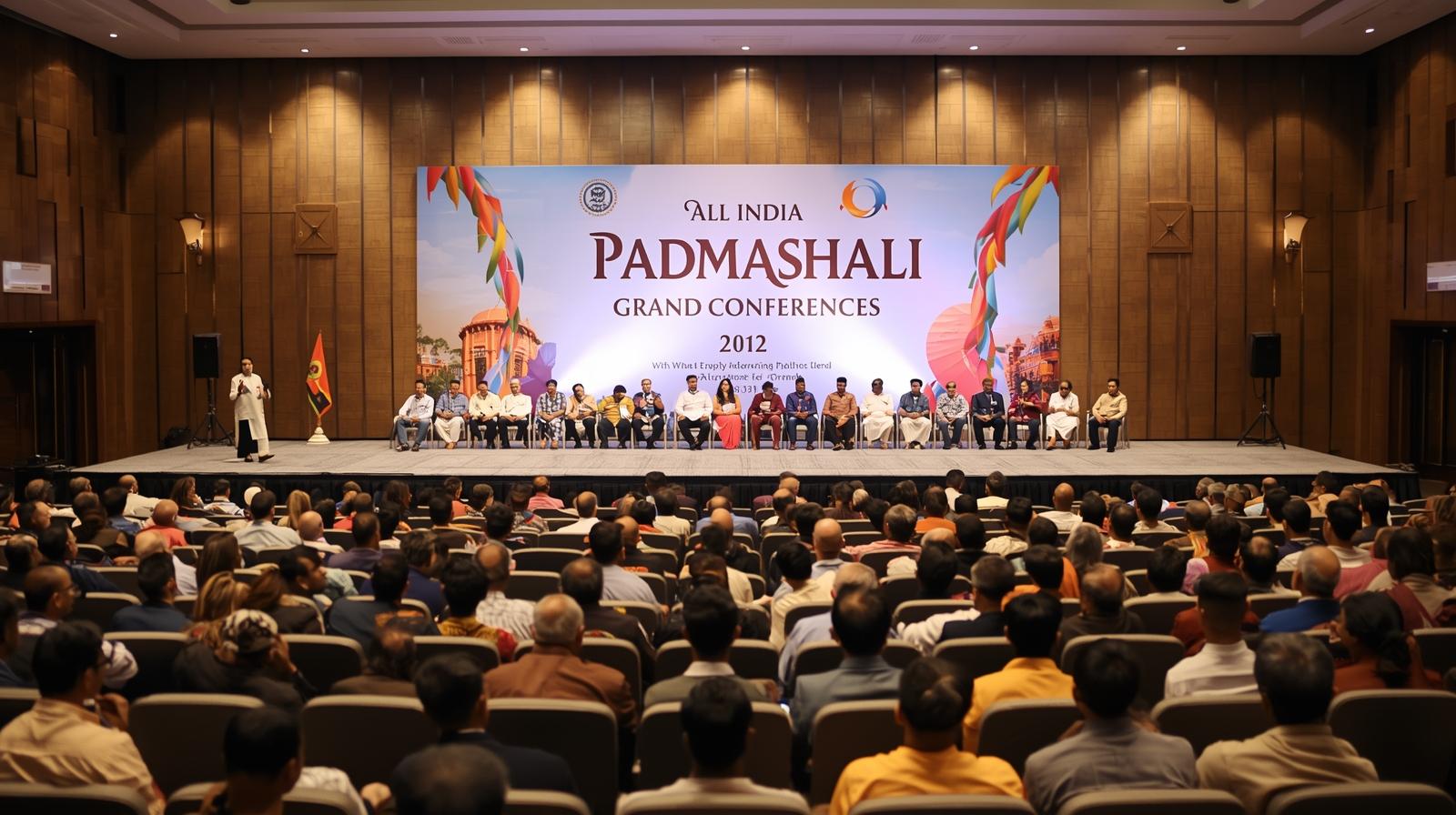
Inspiration
In 1918, the 6th Andhra Maha Sabha was held in Kadapa. Sri Nookala Venkata Subbiah Padmashali, a prominent leader from Appayyaraju Peta, served as the president of the organizing committee. Following his special invitation, Sri Karyampudi Venkata Krishnayya, a poet from Cheeral and Perala regions, attended the event.
• Influenced by the Andhra Maha Sabha, Venkata Krishnayya suggested to Sri Nookala Venkata Subbiah the need for an All India Padmashali Sabha to uplift the Padmashali community.
• After thorough discussions, both leaders decided to establish the All India Padmashali Grand Conference and took steps to organize it.
• As a result, the first grand conference was held on June 22, 23, and 24, 1921.
First Grand Conference
• The first All India Padmashali Maha Sabha was held in Pullampeta, Kadapa district, from June 22 to 24, 1921.
• Sri Akurathi Ranganayaka Swamy, a resident of Evooripalem near Cheeral, presided over the event.
• Sri Karyampudi Venkata Krishnayya poetically invited Padmashali community members from various regions to the Sabha.
• Several resolutions were passed for the community’s development during the event.
• A key resolution was to launch a monthly magazine titled Padmashali, which was later initiated in December 1921 under the editorial leadership of Sri Nookala Chinnayya, who was one of the few Padmashalis of his time with English education.
Second Grand Conference
• The second All India Padmashali Maha Sabha was held from February 23 to 25, 1923, in Mangalagiri, Guntur district.
• To assess and announce the significance of the “Bhavana Rishi” manuscript, a committee was formed under the leadership of Sri Karyampudi Venkata Krishnayya.
• At the end of the 19th century, Sri Purana Kondayya, a respected elder, proclaimed the greatness of Bhavana Rishi from the Markandeya Purana. However, some elders noticed certain misinterpretations in the manuscript regarding the Padmashali community. The need arose to properly examine and clarify these facts.
• The second grand conference instilled a sense of pride and progress in the Padmashali community. The importance of eradicating vices and focusing on education became clear to everyone.
• To ensure continuous education for economically disadvantaged Padmashali children, a “Vidya Nidhi” (Education Fund) was established.
• The main goal of the Maha Sabha was to restore the lost honor and prestige of the Padmashali community.
Opposition Conferences
• After organizing two Padmashali Maha Sabhas, some individuals with selfish motives attempted to disrupt the unity of the community. On November 18, 1923, they held a competing Padmashali Maha Sabha in Perala, attempting to derail the progress made so far.
• In response, All India Padmashali leaders, including Sri Nookala Venkata Subbiah, Sri Karyampudi Venkata Krishnayya, Sri Akurathi Ranganayaka Swamy, and Sri Nookala Chinnayya, organized an emergency Sabha in Cheeral to reaffirm the resolutions passed in the previous two Sabhas and to end the opposition movement.
Third Grand Conference
• The third All India Padmashali Maha Sabha took place on February 11 and 12, 1924, in Kanchipuram, Tamil Nadu, as requested by the local community.
• Sri Tottiparthi Sriramulu Sreshti, a progressive young leader from Elamarru village in Krishna district, presided over the event.
• Several resolutions were passed, aimed at advancing the community, and new energy was instilled among Padmashalis in Tamil Nadu.
• Prominent figures such as Sri Vaddapalli Vithobha from Sholapur, Sri Hakim Sri Davat Janardhan Swami from Hyderabad, and Sri Kodi Narasimha Sreshti from Mumbai participated in the conference.
Fourth Grand Conference
• The fourth All India Padmashali Grand Conference took place on April 26th, 27th, 1925 in Pedana, Krishna district.
• Sri Chunchu Venkatarangam, a resident of Kambam-Bestavarapupeta, presided over the event.
• Recognizing Sri Karyampudi Venkata Krishnakavi as the key figure in the Padmashali movement, the fourth conference honored him with the title of “Padmashali Pitamaha” (Grandfather of the Padmashali community).
• Several resolutions were passed during the conference to take appropriate measures for the development of the Padmashali community, particularly for the advancement of the handloom industry. The conference recommended these measures to the then Madras government.
• With the encouragement of the conference, a Vedic school was established in Bhattiprolu, Guntur district. Padmashalis were also honored as priests after completing training in their community’s traditional rituals.
• The conference was made successful with the contributions of prominent leaders such as Sri Tatiparti Sriramulu, Sri Venkata Krishnayya, Sri Rajamannaru Shatavadhani’s sons, Sri Karyampudi Ramakanth, Sri Pendem Venkataramulu, and Sri Sevoori Lakshminarasayya (M.A.L.I.T.).
Fifth Grand Conference
• The fifth conference took place on April 14th and 15th, 1927, in Nellore, with Sri A.K. Chengalrayasreshthi from the Kanchipuram community presiding over it.
• The original choice for the presidency was Sri Sevoori Lakshminarasayya, but due to his position as a government employee, the Madras government did not permit him to assume the role. Consequently, Chengalrayasreshthi took over as the president.
• The conference recognized and appreciated Sri Pendem Keshavulu for demonstrating expertise in the Tie & Dye method of fabric production. He was awarded the title of “Chitra Vastra Kala Prapurna.”
Sixth Grand Conference
• The sixth All India Padmashali Grand Conference was held from September 13th to 15th, 1929, in Hyderabad.
• At that time, the president of the Kakinada Municipal Corporation, lawyer Sri Damodara Krishnamurthi, presided over the event.
• Prominent Padmashali figures from Hyderabad, including Hakim Vanamala Narayanadasu and Hakim Davat Janardhanaswami, acted as organizers and secretary.
• Thousands of Padmashalis attended the conference.
• It was noted that such a large-scale gathering had never taken place before in Hyderabad, with many praising the event’s success.
• The conference addressed issues such as preventing child marriages, the necessity of sacred thread rituals (Upanayanam), prohibition of alcohol, Vedic rituals, publication of the community’s religious texts, and the advancement of the handloom industry.
• The conference also advocated for the removal of discriminatory taxes imposed on the handloom industry and pledged donations to publish the community’s texts.
• Maharaja Sir Kishen Prasad, the Sultan of Yemen, graced the conference as the chief guest and attended the textile exhibition.
• Sri Madapati Hanumanth Rao, the secretary of the Andhra Sangh in the Nizam’s state, praised the unity displayed by the Padmashalis.
Seventh Grand Conference
• After a ten-year hiatus, the seventh grand conference was held from March 1st to 3rd, 1939, at the Ahobilam temple in Kurnool district.
• Hakim Sri Davat Janardhan Swami from Hyderabad presided over the event.
Ten-Year Break
• Sri Karyampudi Venkata Krishnakavi, the founding figure behind the All India Padmashali Grand Conferences, passed away in 1935 due to health complications. In the following year, Sri Nookala Venkata Subbiah, another important leader, also passed away.
• The absence of these two key leaders led to a ten-year break in organizing the grand conferences.
Resolutions:
• A resolution was passed to publish the Padmashali magazine from Sholapur.
• It was also decided that the eighth grand conference would be held in Sholapur, as recommended by Sri Vaddepalli Vithobha.
Youth and Women’s Associations
• The third Padmashali Youth Grand Conference was held alongside the seventh grand conference, under the leadership of Sri Guntaka Narasayya Pantulu.
• The first and second youth conferences were held separately in 1929 in Hyderabad and in September 1937 in Kambam-Bestavara Peta, Kurnool district.
• On March 3rd, 1939, the All India Padmashali Women’s Grand Conference was held, presided over by Sri Karyampudi Venkata Krishnakavi’s wife, Sri Shyamalaamba.
Eighth Grand Conference
• The eighth All India Padmashali Grand Conference was held from May 16th to 19th, 1941, in Sholapur, with Sri Dheeconda Sayanna presiding over the event.
• The decision to hold the conference in Sholapur was made with the encouragement of Sri Vaddepalli Vithobha.
• Sri Erabattini Narayanarao served as the president of the organizing committee.
• Sri Vaddepalli Vithobha, known for his generosity and service-oriented nature, personally arranged special accommodations for the community members who attended the conference.
• As the first conference held in Maharashtra, the local Padmashali community members discussed their issues thoroughly and passed appropriate resolutions.
Ninth Grand Conference
• The ninth Padmashali Grand Conference took place from April 1st to 4th, 1948, in Sindhchay, Madhya Pradesh, under the presidency of Sri Vaddepalli Vithobha.
• The Women’s Conference was also organized under the leadership of Sri G. Lakshmikantamma.
• Due to the circumstances surrounding the Second World War and the political upheavals post-independence, there was a delay in organizing the ninth conference.
• While the handloom movement had gained significant attention across the country, the Padmashali community’s conferences did not receive as much momentum.
Tenth Grand Conference
• After a 23-year gap, the tenth grand conference was held in Ahmedabad, Gujarat, from April 16th to 18th, 1971, with Sri Erabattini Ashanna presiding over the event.
• A comprehensive discussion on the All India Padmashali Constitution was held during the conference.
• The establishment of regional associations was also a key focus of the conference. It was decided that one regional association would be established in Gujarat, three in Maharashtra, three in Andhra Pradesh, and one each in Tamil Nadu, Karnataka, and Kerala.
• Since fifty years had passed since the first grand conference in 1921, a golden jubilee celebration was also held during this event, presided over by Sri C.V. Subanna Shatavadhani.
Eleventh Grand Conference
• The eleventh grand conference was held in Bengaluru on December 19th and 20th, 1980, with approximately 3,000 people from various regions attending.
• Sri K. Venkata Ramanappa was elected as the president of the conference.
• Prominent leaders like Sri Guntaka Narasayya Pantulu and Sri Konda Lakshman Bapuji participated as chief guests.
• Sri V.S. Krishnayya, Deputy Chairman of the Karnataka Legislative Council, also attended.
• The conference was widely praised for its contributions toward the development of Padmashali youth, with speakers highlighting the need for social, economic, and political progress.
• The conference stressed the importance of providing scholarships for deserving students, building student hostels, and advancing education for the underprivileged.
• A proposal was made to collect donations for the Padmashali Mahasabhas, with Rs. 15,000 raised at the event.
• It was also proposed that Padmashalis in Gujarat and Maharashtra be included in the Harijan and Tribal lists for better access to welfare schemes, which the conference agreed to recommend.
Twelfth Grand Conference
• The twelfth grand conference was held on March 7th and 8th, 1987, at the Exhibition Grounds in Hyderabad, with Sri Guntaka Narasayya Pantulu presiding over it.
• His speech focused on the development of the community and its leadership.
• The experiences from past conferences were shared, highlighting the importance of social development, community consciousness, and the need for strong leadership.
• The conference also emphasized the need for the establishment of student hostels, the necessity of professional societies, and the importance of cooperation in advancing the handloom industry.
13th Grand Conference
• The 13th Grand Conference was held in Sholapur, Maharashtra, in May 1994, under the presidency of Sri Burgul Dasharath.
• Padmashali community members from all over the country attended in large numbers.
14th Grand Conference
• The 14th Grand Conference took place in Hyderabad on May 15, 2001.
• Sri Durgam Narsimha, President of the All India Padmashali Association, presided over the event.
• The Weavers Welfare Trust played a significant role in making the event a success.
15th Grand Conference
• The 15th Grand Conference was held at the Hyderabad Exhibition Ground on May 10 and 11, 2008, under the leadership of Sri Vishwanath Anantmar.
• The conference passed resolutions to strengthen regional Padmashali associations across the country.
• A major discussion was held about the need for the Padmashali community to progress politically.
• Speakers emphasized the importance of unity within the community, advocating for collaboration among all party leaders without any differences.
• Various resolutions were proposed by the presidents of regional associations, and the conference approved them.
• The community members pledged to celebrate the All India Padmashali Association’s upcoming celebrations.
• In the final session, the Chief Minister of the state, Sri Y.S. Rajasekhara Reddy, participated and, after listening to the speeches on the plight of the handloom workers, made several commitments to improve their condition.
